Trumpet Basics +++ English Edition
Trumpet Basics +++
Your Daily Foundation for Confident, Reliable Playing Here you will find a curated set of exercises designed to improve and solidify your performance as a brass player. Like singers, we brass musicians produce our sound entirely with our own bodies. This means our tone production must be ready on demand — whether we are navigating technically demanding passages, playing extended rehearsals, or performing under the pressure of stage nerves. That requires:
- A stable embouchure – even under strain
- Natural, relaxed breathing – free from tension
- Music first – technique always serves expression
These skills don’t happen by chance. They are built through consistent, repetitive practice of specific fundamentals, embedded so deeply that they become second nature — as automatic as walking or breathing. This is where a practice ritual comes in: a structured sequence of core exercises repeated daily until they are woven into your playing habits.
This collection offers such a ritual, incorporating all the essential elements for strong, flexible, and expressive brass playing:
- Inhalation and exhalation with control and awareness
- Targeted airflow for tone quality and stability
- Function of the back of the tongue (tone syllables o – a – e)
- Embouchure stability across the full range
- Strengthening of the embouchure muscles for endurance and flexibility
By making these exercises part of your daily routine, you create the foundation for a reliable, free, and musically compelling performance — every time you play.
Trumpet Basics +++ – The Concept and What’s Behind It
When Routine Isn’t Enough Anymore…
You’ve been playing your instrument for years. You’ve got technique, experience, and probably a fair share of habits – some helpful, others not so much. That’s exactly where Trumpet Basics +++ comes in: this collection isn’t a beginner’s method, but a toolbox for players who want to consciously level up their skills. It all starts with honest self-assessment: Where are you right now, and where do you want to go? Setting a realistic goal and knowing your own staying power already gets you halfway there. Whether you want to improve sound, range, endurance, or control – only with a clear target can your practice move in the right direction. Now let’s talk about implementation. It’s not about practicing for hours, but about creating your own practice formula. Take a close look at how you’ve been practicing so far: Which habits sneak in again and again? What actually works – and what’s holding you back? Once you see that, you can intentionally reshape your practice style.
A key part of this collection is replacing old patterns with new routines. You’ll work specifically on tone production, embouchure setup, tone initiation, and airflow. Air first – then articulation. Feel it before you repeat it. It sounds simple, but often it’s the key to less effort and more control. There are also practical tools like the mouthpiece, Mack, or Buzz-R. They help you sense what’s happening with minimal effort – before the instrument hides things. The crucial part: everything you explore away from the trumpet has to transfer back onto it.
The exercises are structured in phases so you can refine your playing step by step:
- Phase 1 focuses on the tongue – more precisely, the back of the tongue and the tip. You’ll train movement, control, and articulation, always connected with clean air support and conscious tone production. (Exercises 1–4, 5)
- Phase 2 combines tongue work with finger technique. Things get more flexible but also more precise: glissandos, chromatics, observing your intuitive tongue motion, and maintaining sound consistency. (Exercises 6–8, 9)
- Phase 3 targets embouchure stability and lip strength. Bending tones, airspeed control, tonal balance – you’ll realize how little force you really need when everything is in sync. (Exercises 10, 11, 13)
- Phase 4 expands your range and sound by using relaxation as the driving force. Pedal tones, sound checks in high and low registers, jaw support, and tongue flexibility work hand in hand. (Exercises 15, 16, 17, 20)
- Phase 5 merges everything you’ve developed – articulation, air, embouchure, flexibility, and finger work – into musical material. Arban-style exercises, scales, triads, and natural slurs aren’t played mechanically but used with intention. (Exercises 12, 14, 18, 19, 21)
The core idea behind Trumpet Basics +++ is this: you’re no longer practicing “somehow,” you’re practicing with direction. You use your experience instead of fighting your habits. You develop your technique from the inside out – with your ears, mind, body awareness, and a plan that fits your level. If you’re ready not just to practice more, but to practice smarter, this collection is exactly your thing.
Contents and Learning Objectives – At a Glance
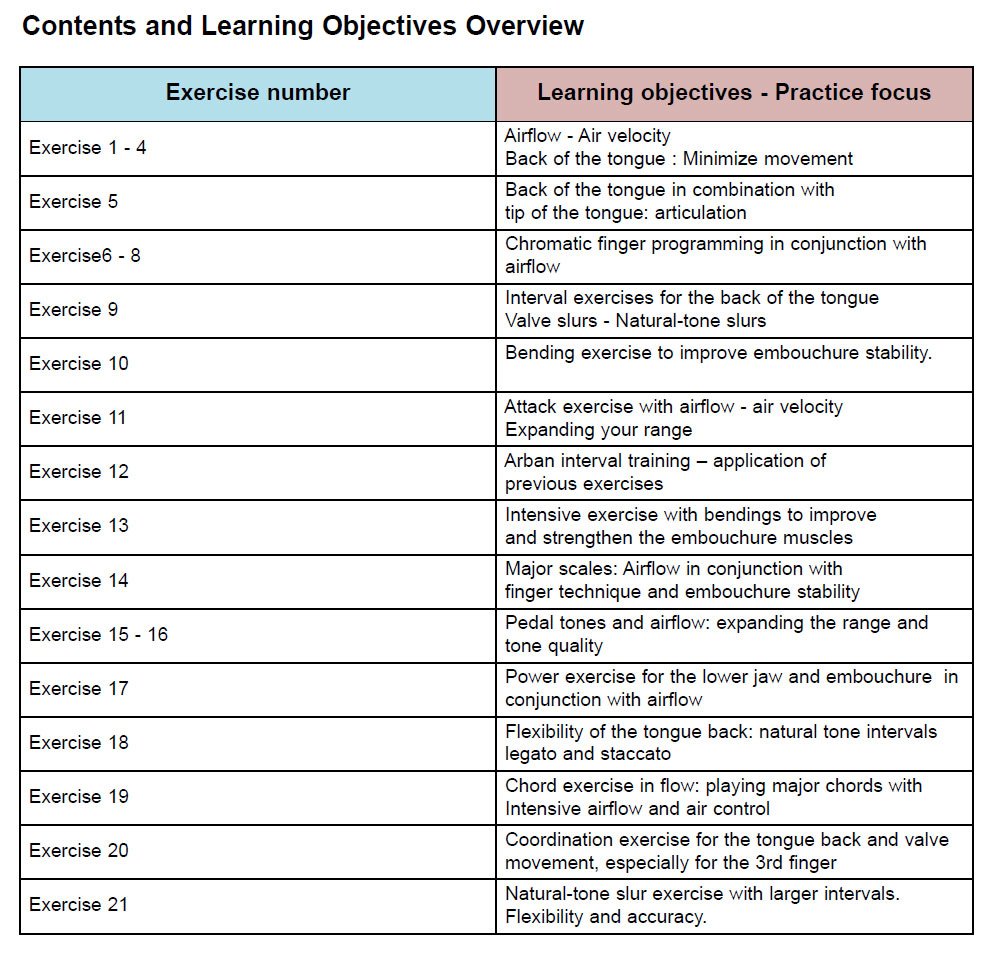
The exercises are organized according to didactic-pedagogical goals and provide a step-by-step development of your technical and musical trumpet playing. You can also easily adapt the order of the exercises to suit your individual practice needs and goals. Many of the exercises are also well-suited for use as warm-ups or strength-building routines.
QR codes to scan
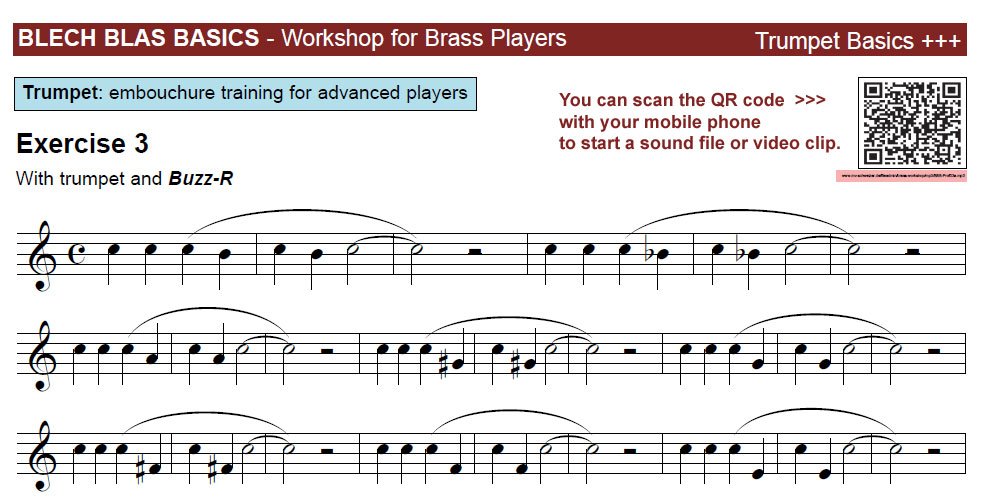
Scan the QR-Code with your smartphone to access an audio file or video clip that provides instructions or play-along options. Please note: the video clips are recorded in German, but very little text is used, so they are still understandable.Download some pages for INFO. → TRUMPET BASICS +++ en-info Excerpt from the complete edition. This download is free.
Example Exercises from Trumpet Basics +++
Trumpet Basics – Exercise 1: Airflow up to C''
Trumpet Basics – Exercise 1
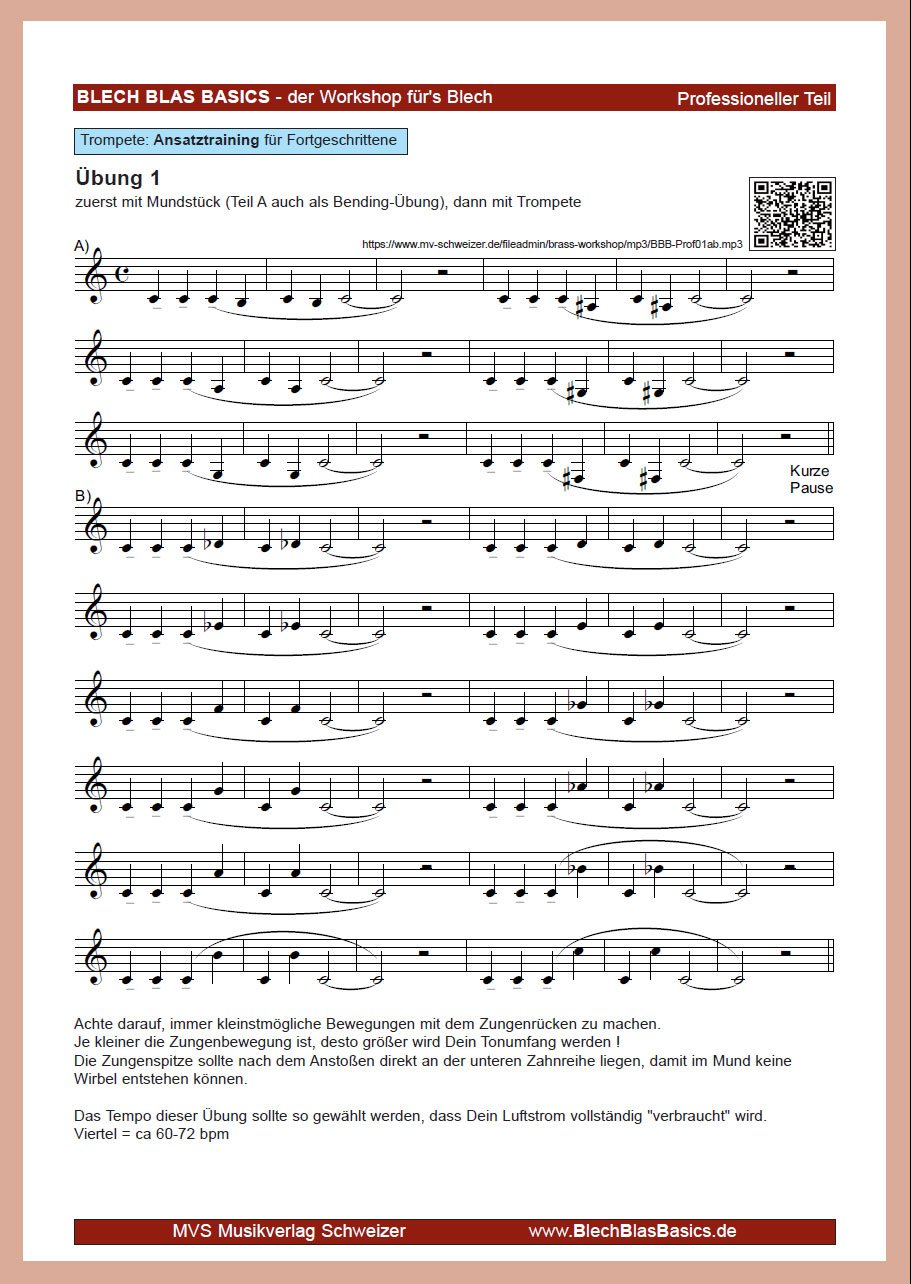
First with the mouthpiece only (part A also as a bending exercise), then with the trumpet.
Keep the movements of the back of your tongue as small as possible. The smaller the tongue movement, the wider your range will become! After tonguing, the tip of the tongue should rest directly against the lower teeth so that no turbulence forms in your mouth. Choose a tempo at which your airstream is completely “used up”. Quarter note = approx. 60–72 bpm.
Trumpet Basics – Exercise 2: Airflow up to G''
Trumpet Basics – Exercise 2
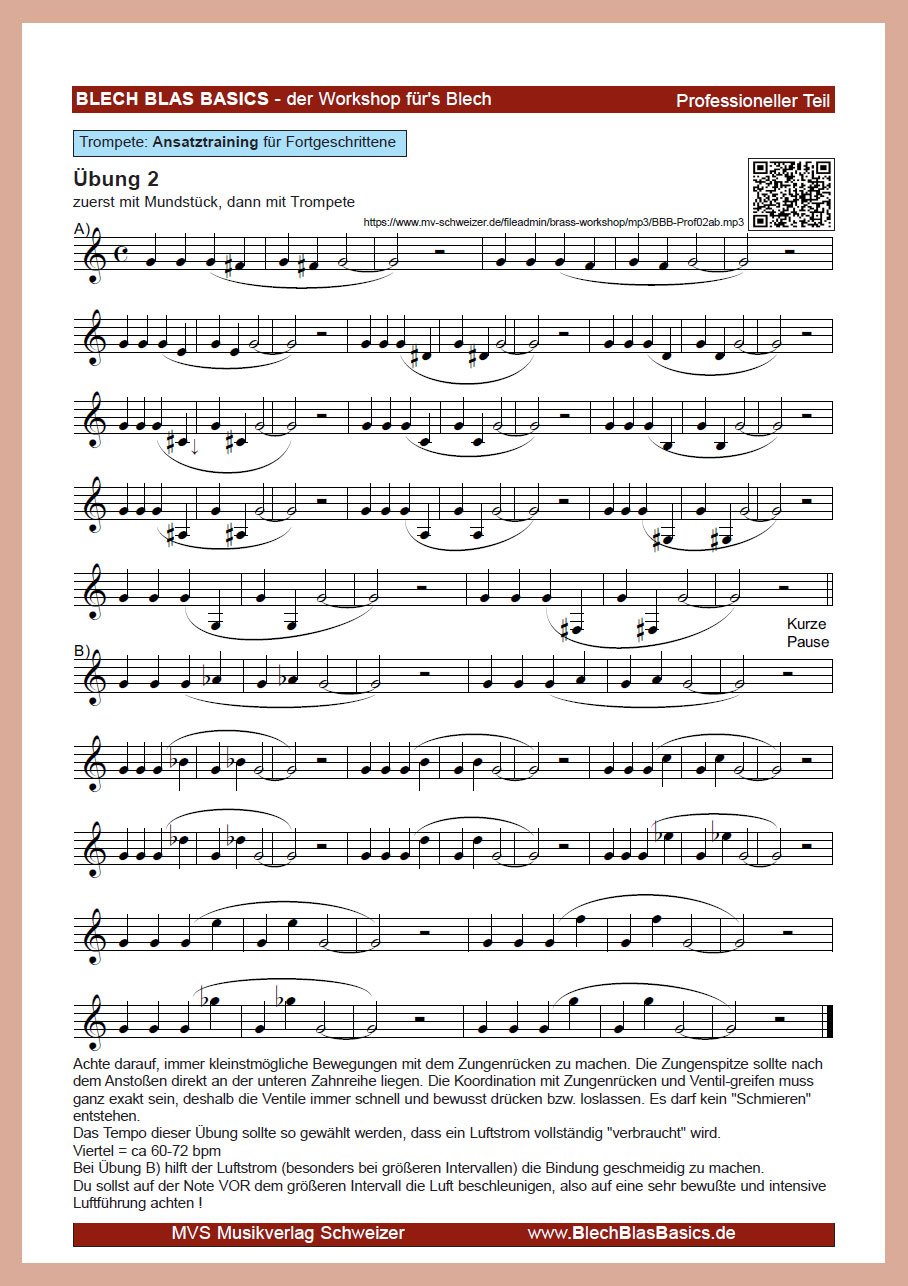
First with the mouthpiece, then with the trumpet. Keep the movements of the back of your tongue as small as possible. After tonguing, the tip of the tongue should rest directly against the lower teeth. The coordination of the back of the tongue and the valve fingers must be very precise, so always press and release the valves quickly and deliberately. There must be no “smearing” between the notes. Choose a tempo at which one breath is completely “used up”. Quarter note = approx. 60–72 bpm. In part B, the airstream helps to make the slurs smooth (especially across larger intervals): speed up the air on the note BEFORE the larger interval, i.e. focus on very conscious and intense air support.
Trumpet Basics – Exercise 10: Smart Warm-up
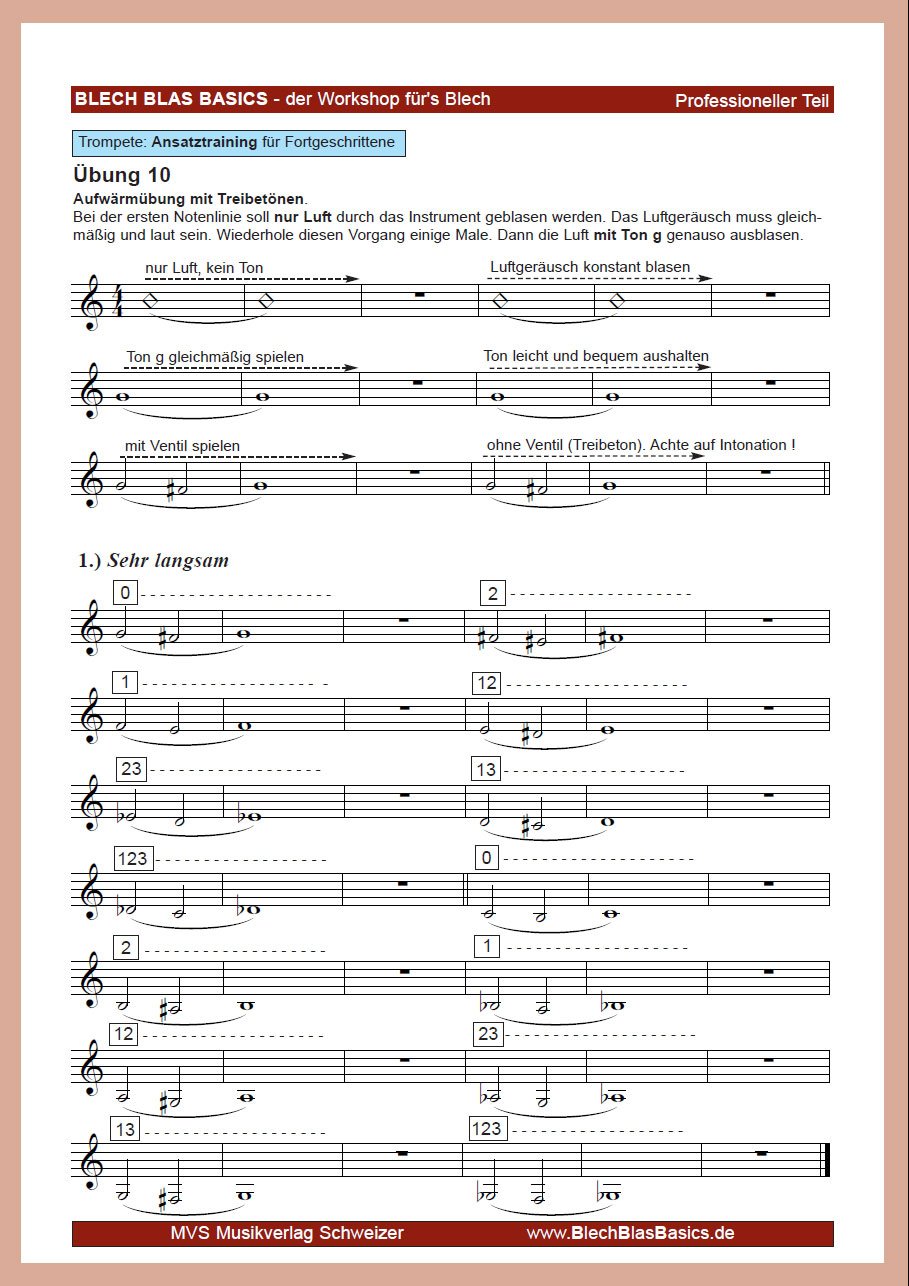
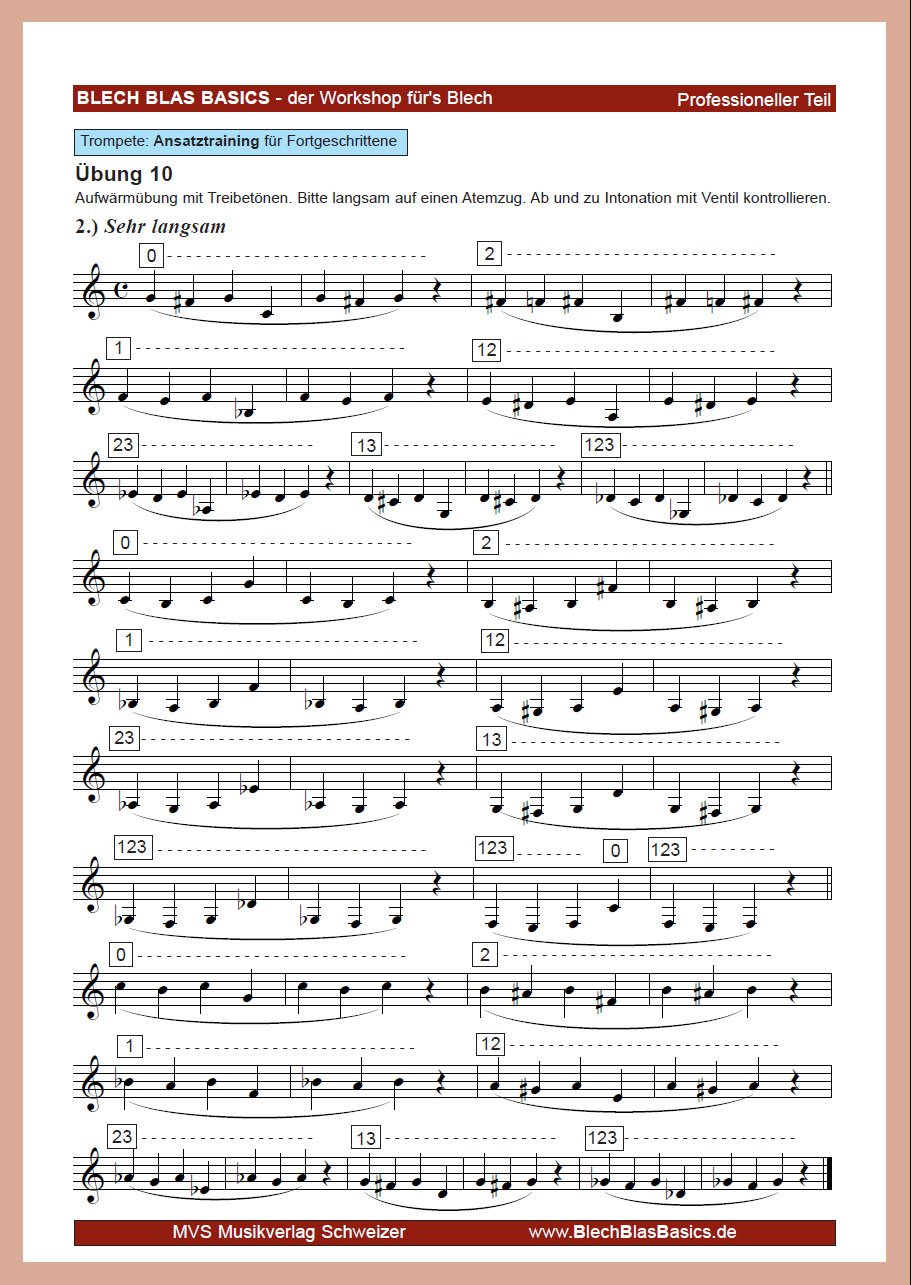
Warm-up with bending tones. On the first line of music, just blow air through the instrument. The sound of the air should be even and loud. Repeat this several times. Then blow the air in the same way while playing the note G. To pitch the bent note accurately, first play F sharp with the 2nd valve. Then try to “bend” the open G down to F sharp, so that it is just as loud and in tune as the F sharp played with the valve.
Trumpet Basics – Exercise 11: Articulation and Extending the Range
Trumpet Basics – Exercise 11
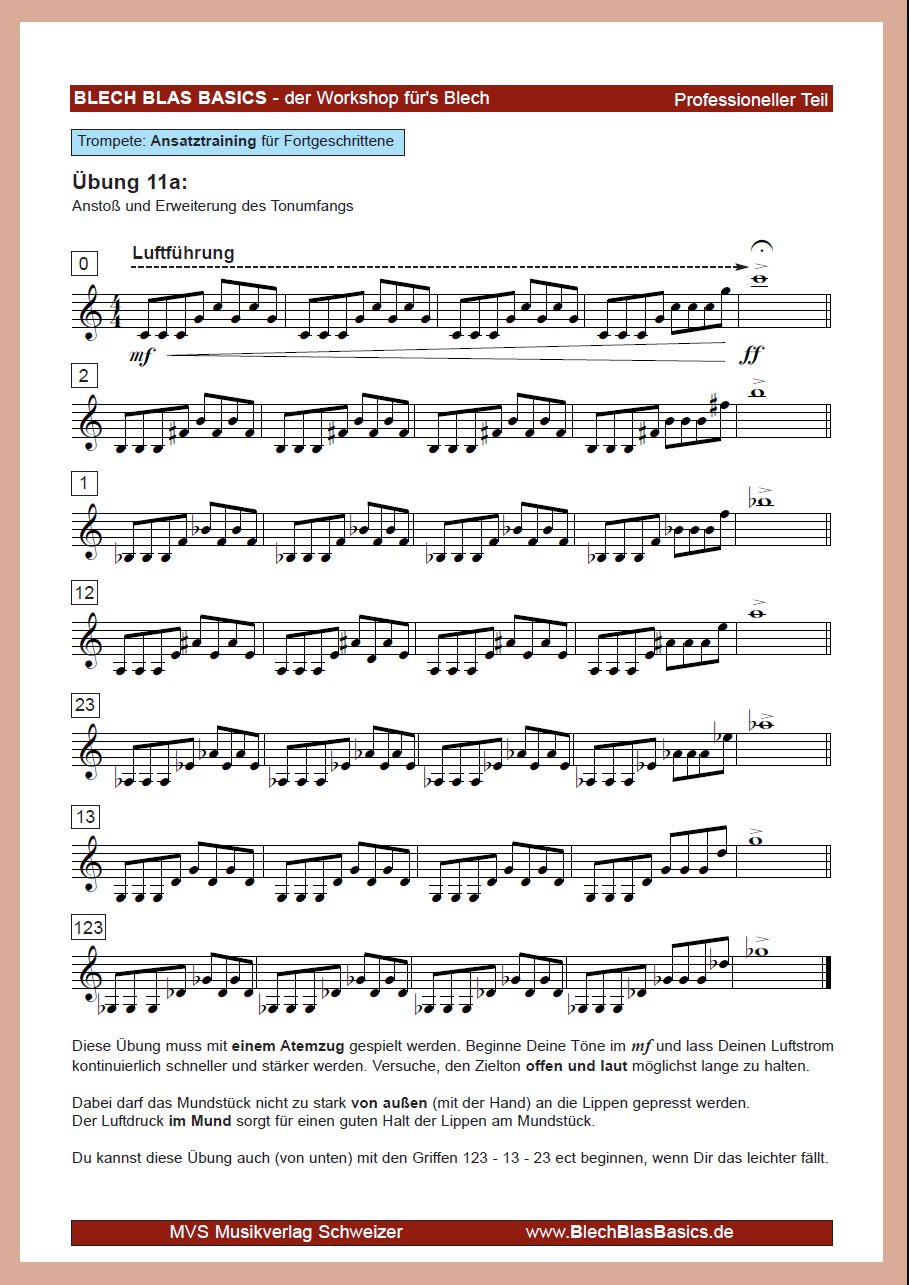
This exercise must be played in one breath. Start your notes at mf and let your airstream become continuously faster and stronger. Try to hold the target note open and loud for as long as possible. Do not press the mouthpiece too hard against your lips with your hand – the air pressure in your mouth keeps your lips in good contact with the mouthpiece. If it is easier for you, you can also start this exercise from below with the fingerings 1-2-3, 1-3, 2-3 etc.
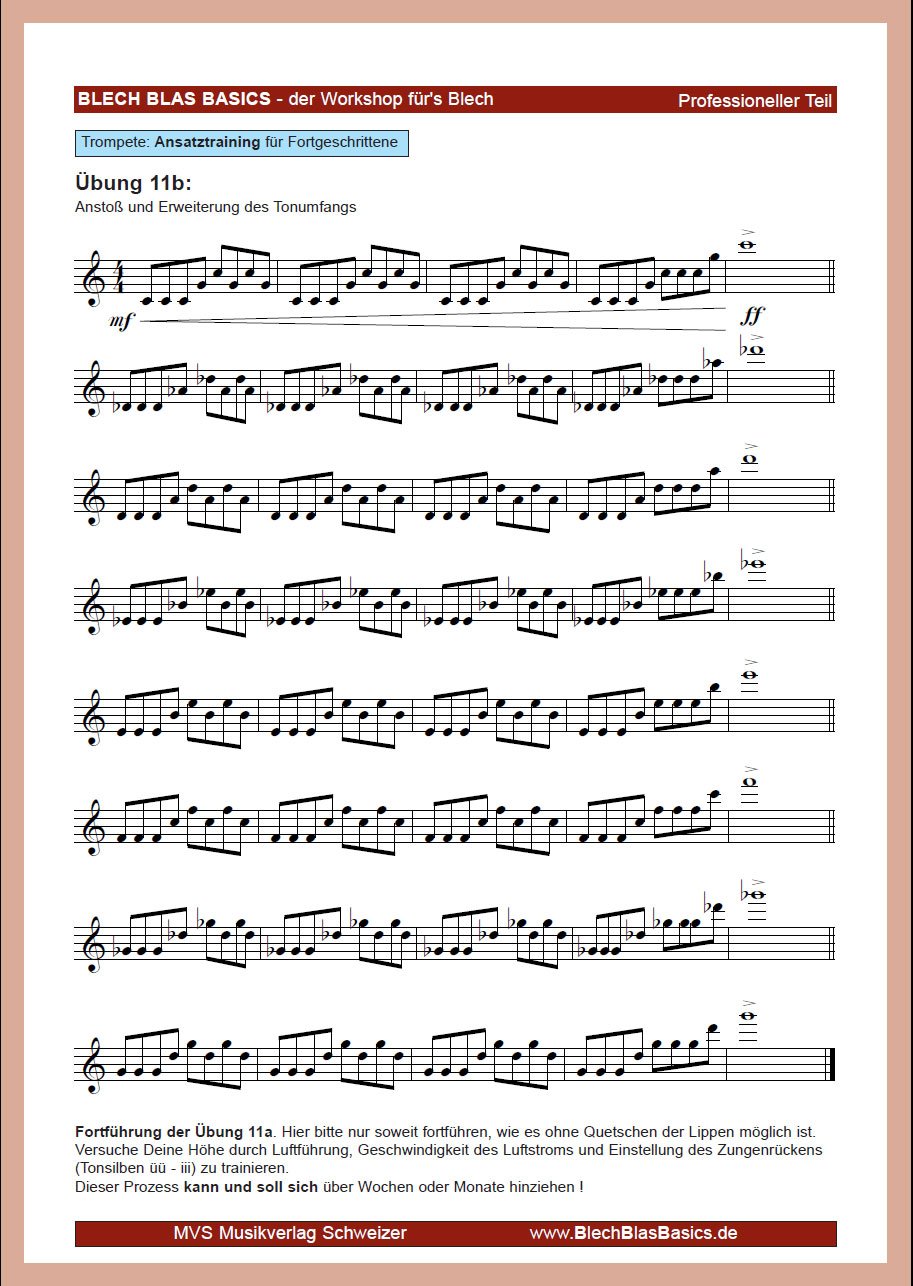
11b) Only continue as far as you can without squeezing your lips. Develop your high register through air support, air speed and the position of the back of the tongue (tone syllables ü – i). This process can and should take weeks or months!
Trumpet Basics – Exercise 11b
- Complete edition as PDF with all QR codes: TRUMPET BASICS +++ en-pdf – order in our online shop
- Download some pages for information: → TRUMPET BASICS +++ en-info (excerpt from the complete edition, free of charge)
Advanced embouchure training – with this programme for breathing, embouchure and technique you can noticeably improve your trumpet playing in a short time.
The complete English edition (PDF with all QR codes, EUR 24.90) can be ordered directly in our online shop. You can pay with PayPal or by bank transfer; after payment you receive the PDF as a download.